
Why Privacy Matters for Journaling: What Research Shows
Table of contents
Privacy matters because concern about an audience can change what someone is willing to record. Disclosure studies suggest that perceived anonymity or privacy can increase personal disclosure, but research has not established privacy as a universal precondition for journaling benefits. The practical case for privacy is still strong: a journal may contain information whose exposure could cause personal, social, legal, or safety harm.
This article separates those two questions: what disclosure research can reasonably imply about self-censorship, and what technical safeguards can and cannot protect in a digital journal.
What Happens When You Self-Censor Your Journal?
Self-censorship in a journal is rarely deliberate. You do not sit down and decide to lie to yourself. Instead, it happens in small, almost invisible ways.
You soften a criticism of someone close to you — just in case. You skip an entry after an embarrassing day. You reach for a word that feels safer than the one that is accurate. You write around the thing that is really bothering you rather than through it.
Over time, these small edits can produce a more selective record. That may matter if your purpose is to explore material you are avoiding, but the evidence does not let us calculate how much benefit a particular omission changes.
A journal does not need total disclosure to be useful. It does need a privacy model that matches the sensitivity of what you choose to put in it.
What Does the Research Say About Privacy and Honest Writing?
Expressive-writing protocols often attempt to create a confidential setting, but confidentiality, anonymity, and privacy are not the same thing.
James Pennebaker, the psychologist at the University of Texas at Austin who pioneered expressive-writing research in the 1980s, commonly told participants to write for themselves and described how their pages would be handled. Researchers could still collect or analyse writing in many studies; “confidential” does not mean no researcher could connect any text with a participant.
In a sole-authored review published in Perspectives on Psychological Science (2018), Pennebaker described the field's history and unresolved mechanisms. It does not establish that polished or self-censored writing loses a predictable share of benefit.
A 2006 meta-analysis by Joanne Frattaroli examined 146 experimental disclosure studies and found a small overall effect. Studies conducted in private rooms initially appeared to have larger effects than those in shared rooms, but that association disappeared after controlling for study setting. This supports a measured privacy inference, not the claim that privacy was a proven active ingredient.
A 2018 clinical trial by Smyth and colleagues tested Positive Affect Journaling. Research staff screened saved entries, so the trial cannot be used as evidence that no one reads effective writing or that authenticity itself caused the outcomes.
Adam Joinson's 2001 experiments found greater self-disclosure in some computer-mediated conditions associated with visual anonymity and private self-awareness. The study was not about journals, so applying it to diary writing is an inference.
Perceived privacy can influence disclosure. Whether that change alters a journaling outcome, and by how much, remains an open empirical question.
Why Do Digital Journals Create a Particular Privacy Problem?
A paper notebook has a comparatively visible access path: someone generally needs physical access to the notebook, a copy, or a captured image. Homes, desks, disposal, and photographs can still expose it, so paper is not automatically private.
A digital journal's access paths depend on its design. Content may remain only on a device, synchronise through a cloud account, or travel to a provider's servers. Each model can involve devices, account holders, employees, infrastructure providers, legal processes, backups, and security breaches in different ways.
Encryption labels need context. Server-side encryption — where the service can access decryption keys — can protect stored data if an attacker obtains only the underlying storage, but it does not prevent authorised service systems, a compromised system with key access, or a valid legal demand from reaching plaintext.
For a detailed breakdown of who can actually access your digital journal and what each type of encryption protects against, see our article on who can read your digital journal.
The problem is not that app companies are necessarily malicious. It is that storage design determines what employees, vendors, cloud providers, attackers, account holders, or legal processes may be able to access. Some users may also write differently when they understand those possibilities, although that behavioural effect has not been tested directly in journaling apps.
What Does Pennebaker's Inhibition Hypothesis Actually Say?
Pennebaker's early inhibition hypothesis proposed that actively suppressing important experiences could create physiological strain and that disclosure might reduce some of that burden. Later work has considered cognitive organisation, exposure, emotion regulation, and social processes as alternative or complementary explanations.
The hypothesis should not be presented as a proven linear mechanism in which every softened sentence leaves a proportional amount of physiological stress behind. Nor does it show that a technically private journal automatically produces uninhibited writing.
Privacy may make disclosure easier, but the expressive-writing literature has not identified privacy or inhibition release as a universal active ingredient.
What Does Real Privacy Look Like in a Journaling App?
No two features create absolute privacy, but several architectural questions materially change who can access journal content.
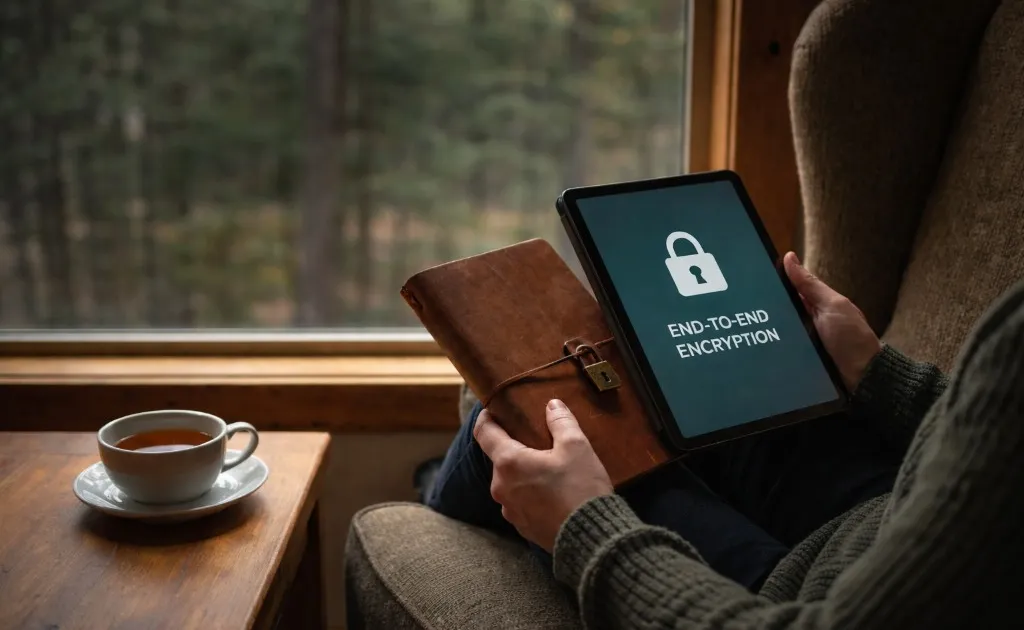
End-to-end encryption (E2EE).
With correctly implemented E2EE, journal content is encrypted before it reaches the service and the provider does not hold the content-decryption key. Keys may be generated, stored, recovered, or derived in different ways; password derivation is not universal. E2EE can protect stored content from the provider, but it does not eliminate risks from compromised endpoints, shared credentials, metadata, backups, exports, or recovery mechanisms.
User-owned storage.
Some apps store data in a cloud account you choose rather than on the app developer's servers. That can reduce the developer's role and improve portability, but the cloud provider, account-recovery design, connected apps, and device security still matter. A developer disappearing can also affect future compatibility even when the files remain.
E2EE and user-controlled storage can reduce provider access. They do not justify the absolute answer “only you” without examining endpoints, keys, metadata, sharing, backup, and recovery.
How Might Perceived Privacy Affect What You Write?
Joinson's computer-mediated experiments suggest that anonymity and private self-awareness can affect disclosure in some settings. Journaling apps have not been directly tested, and people may respond differently to the same storage design.
If concern about a reader changes your wording, you might soften an emotion, omit a conflict, or avoid identifying detail. Those choices are not automatically harmful: withholding names or sensitive facts can be prudent data minimisation.
These differences may matter to the writer, but research does not identify these exact forms of disclosure as universally most beneficial. Our article on whether journaling helps with anxiety reviews the more limited evidence for specific writing tasks.
A written record can make some claims or options easier to inspect, but it does not force honesty or guarantee clearer decisions, self-understanding, or learning. Our piece on whether journaling can help you think more clearly separates those practical affordances from direct evidence.
Privacy concerns may also affect whether and when someone writes, but the studies cited here did not test journal-writing frequency. Our guide on how to start a journaling habit applies general habit research and does not establish consistency as a predictor of lasting journaling benefit.
How Can You Evaluate Your Journal's Privacy?
If you are unsure whether your current journaling setup is genuinely private, here are four questions worth checking.
Is end-to-end encryption enabled?
Do not infer protection from a feature list. Check whether E2EE applies to journal content, whether it is enabled for your account and devices, and how keys, recovery, sharing, exports, and backups work.
Where are your entries stored?
On the company's servers, or in cloud storage you control? The answer determines whose rules govern your data and who else might have standing to access it.
Does the app have a passcode or biometric lock?
An unlocked or shared device is one important access path, alongside account compromise, cloud access, exports, backups, and provider-side access. If your app offers a lock, decide whether enabling it fits your threat model.
What is the company's business model?
Read the privacy policy and business model, whether the app is free or paid. Price alone does not determine data practices; look for clear statements about collection, access, sharing, retention, deletion, and independent security review.
For a more detailed checklist, including what to look for in privacy policies and how different encryption types compare, see our guide on who can read your digital journal.
A useful review names the person or system you are protecting against and tests each access path separately. No single badge answers every threat.
Start With a Threat Model, Not a Privacy Label
“Private” is not one technical state. Begin with two questions: what would be harmful if it were exposed, and who are you trying to keep it from? A casual visitor, a family member who shares a tablet, an employer controlling a work device, the app provider, a cloud provider, an account thief, and a determined forensic attacker are different threats. One safeguard will not address all of them.
A local passcode can reduce casual access while doing nothing about an already unlocked device or a synchronised copy. End-to-end encryption can reduce provider access to content while leaving metadata — such as account identity, timestamps, device information, or file sizes — visible. User-controlled cloud storage may improve portability while inheriting the security and recovery rules of that cloud account.
Backups and exports deserve the same scrutiny as the main database. An encrypted app may create an unencrypted PDF, email attachment, notification preview, or operating-system backup. Deleting an entry from the visible interface may not immediately remove every retained copy. Check what the product documents, and do not infer guarantees that it does not make.
Device security remains part of journal security. Use a supported operating system, a strong device credential, appropriate auto-lock settings, and account protections such as multi-factor authentication where available. Consider whether journal text appears in notifications, search indexes, widgets, keyboards, or recent-app previews. These steps reduce particular risks; they do not create absolute secrecy.
Finally, choose the amount and type of detail according to the consequences of exposure. You can keep names or identifying details out of an entry, separate highly sensitive material from ordinary notes, or use paper stored in a controlled place. Writing less is not a psychological failure. It is a legitimate data-minimisation decision when the security available does not match the sensitivity of the information.
A privacy design should be judged against concrete access paths, not against promises of “complete privacy.”
Review where content is stored, whether content is end-to-end encrypted, how keys and recovery work, what metadata is collected, and how local devices are protected. Choose the setup whose safeguards match the sensitivity of what you write.