
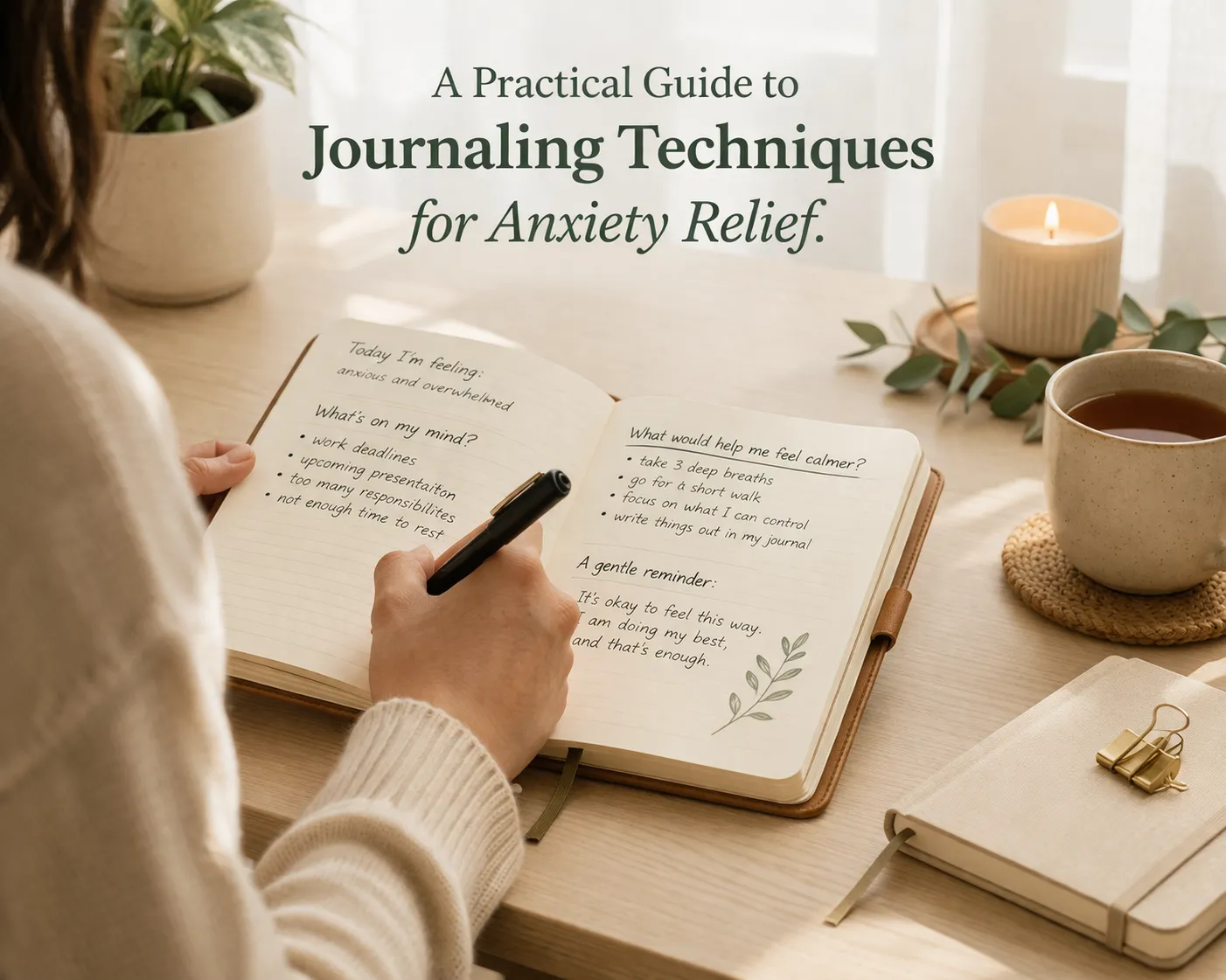
How to Journal for Anxiety: A Practical Guide
Table of contents
If you are anxious right now, a journal may or may not be useful. Structured writing studies report small, mixed average effects in particular populations; they do not establish a fifteen-minute remedy or one method that reliably reduces anxious thinking.
This guide offers five bounded exercises and separates direct evidence from adjacent theory. Stop if writing intensifies distress, and do not use it instead of assessment, treatment, or crisis support.
If you want the deeper evidence base, our article on whether journaling helps with anxiety covers the research in detail. This article is the practical companion. It is about what to actually do.
Why does writing help with anxiety — and why does it sometimes not?
Anxiety is not simply a thinking problem, and writing does not automatically interrupt it. A written task can make a concern more concrete or reveal repetition, but it can also prolong attention to threat.
In an fMRI task by Lieberman and colleagues (2007), selecting an emotion label for facial expressions was associated with greater right ventrolateral prefrontal activity and lower amygdala activity than an affect-matching condition. Participants did not journal, and the study cannot show that writing goes further or that narrative construction is the active ingredient.
But here is where most advice on writing in a journal goes wrong. Not all writing does this. Some writing makes anxiety worse.
Rumination research distinguishes brooding and reflective-pondering factors, but those questionnaire constructs were not assigned journal conditions. Negative emotion, unstructured prose, and rumination are not interchangeable.
Watkins's review of constructive and unconstructive repetitive thought discusses how valence, context, and level of construal can influence outcomes. It is not evidence that one concrete journal question reduces anxiety or that abstract writing is always harmful.
Some expressive-writing studies have associated changes in causal and insight words with outcomes. These are group-level linguistic associations, not a vocabulary checklist or proof that gradual meaning construction causes benefit.
No single active ingredient has been established. A useful prompt can add structure without guaranteeing improvement.
The practical implication:
The exercises below make their purpose explicit. That may help you monitor what the task is doing, but structure does not prevent brooding or make an exercise safe for everyone.
What should you know before you start?
Two things worth knowing before you open your journal.
First: the research does not establish a personal timeline.
A 2023 meta-analysis by Lin Guo combined depression, anxiety, and stress across 31 trials and reported a small delayed average effect. Trials spaced one to three days apart had stronger average effects than trials with longer gaps. That study-level moderator is not an anxiety-specific schedule, and a lack of immediate benefit is not evidence that effects are accumulating.
Second: writing in a journal is not the right tool for everyone in every situation.
If anxiety significantly affects daily functioning, contact a healthcare professional rather than relying on a journal. If you may act on thoughts of suicide or self-harm, or someone is in immediate danger, contact local emergency services now. Find A Helpline lists verified crisis services in more than 175 countries. Our article on whether journaling can replace therapy explains the boundary.
Which five bounded exercises could you consider?
These exercises draw on different studies and clinical tools. No validated rule predicts which will help an individual, and some should be used only with professional guidance.
1. The worry dump with a concrete next step
Best for:
The scattered, unfocused anxiety of too many things at once. Busy-brain anxiety. The feeling that your head is full.
What the evidence does and does not show:
In laboratory studies by Masicampo and Baumeister, participants whose important unfinished goal was activated showed interference on other tasks. In one study, making a specific plan for that goal reduced the interference; simply writing about the goal did not. The experiments did not test an anxiety journal, prove that a list frees working memory, or show that the brain treats paper as a substitute for remembering.
How to do it:
Open a fresh page and list the concerns competing for your attention. Keep this brief enough that it does not become an inventory of every possible threat.
Choose only the items you can act on. For each, write one realistic next step, including when or where you will do it if that is useful: not "deal with the tax situation" but "email my accountant tomorrow morning." Mark concerns that are not currently actionable instead of inventing a plan for them.
The page is now a record you can return to. Notice whether making the plan changes your attention; do not assume that recording a concern has resolved it.
What to watch for:
If listing expands the worry, or the same concerns return without useful action, stop rather than repeatedly rehearsing them. Another exercise—or support from a clinician—may fit better.
2. Define one bounded worry
Best for:
A specific concern that is vague enough to be difficult to evaluate, but that you can approach without becoming overwhelmed.
What the evidence does and does not show:
Goldman and colleagues' preliminary study randomly assigned 30 nonclinical high worriers to written exposure or control writing. Self-reported worry, depression, and some generalized-anxiety symptoms decreased over time in the exposure group, while one symptom also decreased in the control group. This small study does not establish that an unguided worst-case journal is safe or effective treatment. Exposure is a clinical technique that may be better planned with a qualified professional.
How to do it:
Name one concern in a sentence: what might happen, what is known, and what remains uncertain. Then divide a page into three short sections: evidence you have now, information you could reasonably seek, and one action within your control. You do not need to construct a vivid worst-case scene.
The aim is modest: distinguish a testable concern from a prediction. Specificity can make the question easier to inspect, but it does not necessarily make fear less powerful.
If a practical response exists, finish with "One step I can take is…" If no action is available, write that explicitly and choose whether continued writing is useful right now.
What to watch for:
Stop if the exercise increases distress, urges, panic, or repetitive checking. Do not repeatedly write feared scenes as self-directed exposure; ask a clinician about an appropriate approach if avoidance or worry is substantially affecting your life.
3. The thought record
Best for:
A specific anxious thought that keeps returning. The "I am going to fail / something is wrong / I cannot cope" variety.
What the evidence does and does not show:
Thought records are worksheets used within cognitive behavioural therapy (CBT). In an experiment by McManus, Van Doorn, and Yiend, both a thought record and a behavioural experiment changed a selected belief relative to a control condition, with some advantages for the behavioural experiment. That comparison does not isolate a therapeutic effect on an anxiety disorder, establish that a journal works like CBT, or identify changes in causal words as the mechanism.
How to do it:
Draw four columns, or write four sections:
The thought:
Write the anxious thought exactly as it appears. "I am going to fail this presentation." "Something is wrong with me." "I cannot handle this."
Evidence that supports it:
Record observable facts that support the thought. Separate those facts from feelings, predictions, and assumptions.
Evidence that does not support it:
Record observable facts that contradict or qualify it. What has actually happened before? What information is still missing?
A more balanced version:
Write a statement that accounts for the evidence from both columns. Not a forced positive ("everything will be fine!") but an honest reckoning: "I have felt this way before presentations before and have handled them. I may feel anxious, and I am also capable."
Finally, rate how strongly you believe the original and revised statements. The exercise may reveal alternatives; it need not produce relief. A clinician can help adapt a thought record when doing it alone becomes another form of reassurance-seeking or self-criticism.
4. Self-compassion writing
Best for:
Anxiety that comes with a self-critical edge. The kind where anxious thoughts come packaged with commentary about what your anxiety means about you.
What the evidence does and does not show:
After a negative-mood induction, 186 participants in Odou and Brinker's experiment were assigned to write about a negative event either self-compassionately or expressively. The self-compassion condition showed greater short-term mood improvement, while greater rumination was associated with less improvement. This was a mood experiment, not a trial of anxiety treatment, and it did not establish one ingredient that works for everyone.
How to do it:
Write a letter to yourself from the perspective of a good friend who knows you well and cares about you. Describe what you are going through. Acknowledge that it is genuinely difficult. Remind yourself that struggling with anxiety is something many people experience — not a sign of weakness or deficiency specific to you.
Write what your friend would say: what they see in you, what they would encourage, what they would gently challenge.
The friend perspective is one way to cue a kinder tone. The study does not establish that second-person grammar creates psychological distance or that a letter is superior to every other format.
If the letter format feels forced, try a simpler version: write three sentences. "What I am going through is hard. Many people feel this way. Here is what I would say to a friend in my situation."
5. Three good things
Best for:
Trying a brief record of positive events alongside—not instead of—acknowledging a difficult period.
What the evidence does and does not show:
A meta-analysis by Cregg and Cheavens combined 27 studies of varied gratitude interventions and found small average reductions in pooled depression and anxiety symptoms at post-test and follow-up. Effects were larger against waitlist than active controls, and the authors recommended treatments with stronger evidence for people seeking symptom reduction. The analysis does not isolate a three-item journal, prove attentional retraining, or establish an anxiety treatment.
How to do it:
If the exercise does not feel invalidating, write up to three things you appreciated or that went better than expected. Be specific enough to remember the event. Do not use the list to deny fear, loss, discrimination, danger, or another problem that needs action.
No frequency has been established as best for anxiety. The studies varied in task, duration, population, and comparison group, so choose a frequency that remains voluntary and useful rather than treating novelty or repetition as a proven mechanism.
What determines whether any of this works?
No study establishes one requirement shared by all five exercises. Topic, context, expectations, symptom severity, comparison condition, and the support around an exercise can all matter.
It can still be useful to notice whether an imagined audience changes what you record. You are allowed to omit details, write indirectly, or choose not to write. Full disclosure is not a test of courage and has not been established as the mechanism behind health outcomes.
Some expressive-writing protocols tell participants that their writing is confidential, but a research protocol is not proof that secrecy activates an effect. Privacy is instead a practical and ethical consideration: use a medium and setting where you understand who may have access.
You control what you disclose. If a prompt feels coercive, unsafe, or too activating, pause or choose another form of support.
Digital and paper journals carry different access, loss, and disclosure risks. Our articles on who can read a digital journal and cloud journal storage explain questions to ask. No storage method is risk-free.
How can you start today?
If you want to try an exercise, pick one that feels manageable. You do not need to complete all five or use a timer.
Decide on a short stopping point before you begin—a few lines, one question, or a time limit you choose. Afterwards, note whether you feel steadier, unchanged, or more distressed. That observation is more useful than assuming discomfort means the exercise is working.
There is no established three-to-four-times-per-week dose for these combined exercises and no basis for promising that effects compound. Repeating an exercise is optional. If it repeatedly increases distress or consumes more time without helping, stop and reassess.
We do not know a single most common reason writing fails, and structure cannot guarantee that a prompt will prevent rumination. Use these as optional observations, not rules. If you want other low-pressure topics, our guide on what to write in a journal offers additional prompts.
A journal can be one small tool alongside rest, practical help, social support, and evidence-based care. It does not have to get anxiety “out of your head” to count as a useful record—and you can close it at any point.