
Does Journaling Improve Emotional Intelligence?
Table of contents
Does journaling improve emotional intelligence? The research on writing and emotion offers a conditional yes. Putting a feeling into words reduces amygdala activity and engages the prefrontal regions responsible for regulation; people with a richer vocabulary for emotion regulate them more flexibly; and writing is the natural environment for the small linguistic shifts — naming precisely, distancing from the first-person grip — that produce these effects. None of this happens automatically. A page filled with "I feel bad" repeated in different shapes does not build emotional intelligence. A page that reaches for the specific word does.
The honest answer is yes, but only for the writing that engages the underlying mechanisms. Most of what we mean by emotional intelligence is a set of skills that the page is unusually well suited to exercise — provided the writing names rather than merely vents.
What Is Emotional Intelligence?
The most defensible definition of emotional intelligence comes from John Mayer at the University of New Hampshire, Peter Salovey at Yale, and David Caruso, who introduced the construct in the 1990s and refined it in a 2008 paper in American Psychologist. Their ability model treats emotional intelligence not as a personality trait but as four cognitive skills that can be measured and improved.
The four branches sit on top of each other. Each one is a prerequisite for the next.
- Perceiving emotion. Noticing what you and others are feeling, in faces, voices, situations, and the body.
- Using emotion to support thought. Letting a mood or feeling inform attention, judgement, and creative work — rather than fighting it.
- Understanding emotion. Knowing what emotions mean, how they combine, and how they change over time.
- Managing emotion. Regulating your own and other people's feelings to reach a goal.
The popular trade-book model — Daniel Goleman's blend of self-awareness, motivation, empathy, and social skill — covers similar ground but mixes ability with personality. The Mayer–Salovey–Caruso ability model is the version that most researchers use and the one with the cleanest line back to studies a journal practice can plausibly affect.
Three of the four branches — perceiving, understanding, and managing your own emotion — are private. They live inside one head. That is exactly the territory journaling can plausibly enter.
How Writing Names What You Are Feeling
The first move in emotional intelligence is the simplest and the easiest to skip: putting the feeling into a word. Until that happens, you are inside the feeling. After it happens, you are next to it.
Matthew Lieberman and colleagues at UCLA showed in a 2007 paper in Psychological Science that this move has a neural signature. Participants who labelled the emotion shown on a face — choosing "angry" or "scared" — showed reduced activity in the amygdala and increased activity in the right ventrolateral prefrontal cortex compared with participants who simply matched the face to a similar one. Putting feelings into words, the authors concluded, recruits the same regulatory circuit that deliberate emotion regulation strategies use, but with no instruction to regulate. The naming itself does the work.
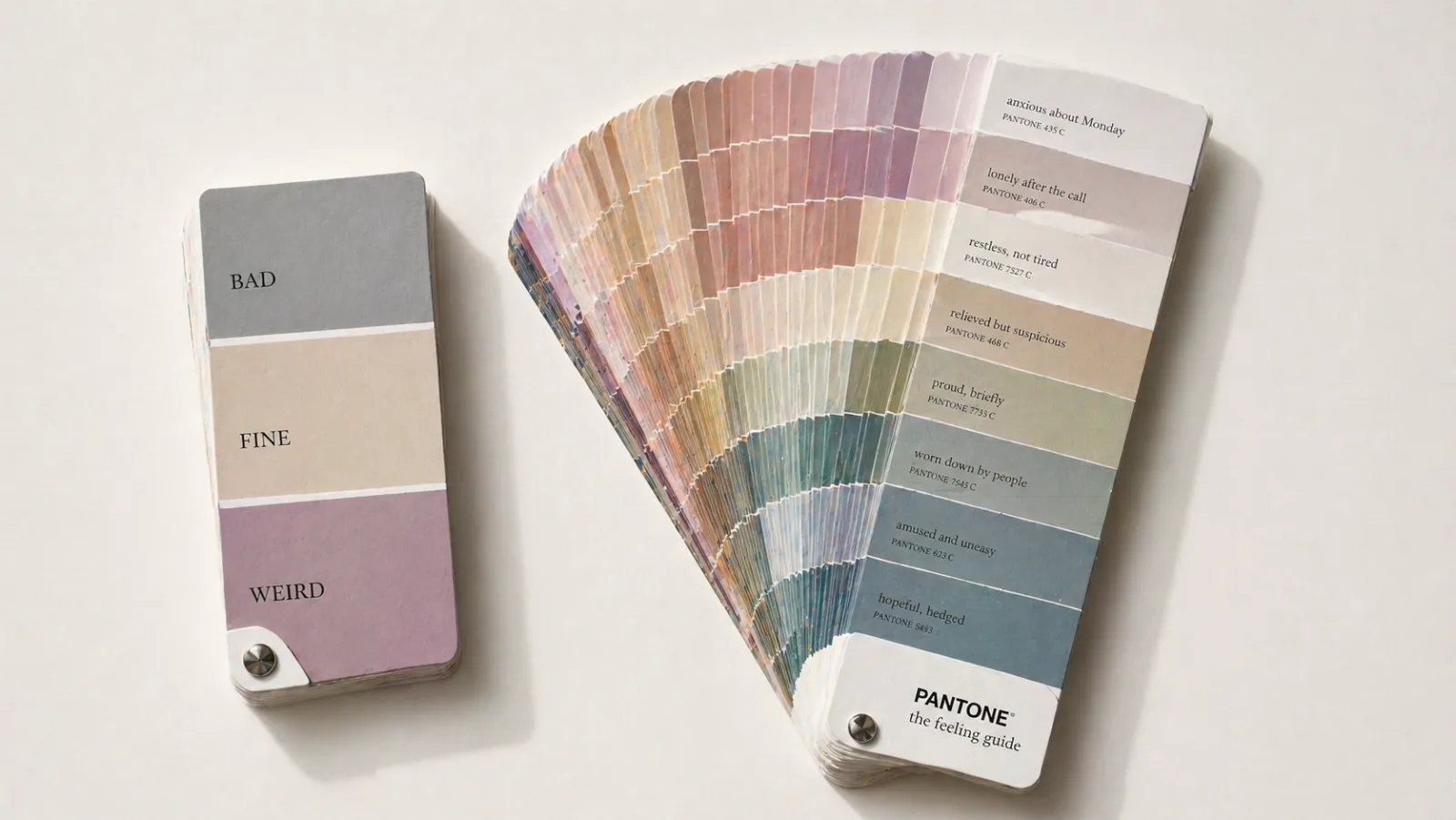
The effect is greater for specific labels. "I feel betrayed" does more cognitive work than "I feel bad." "Lonely after the call" does more than "off." Journaling that pushes for the word that fits — and rejects the first generic one if it does not — exercises this mechanism repeatedly.
A vague feeling is a feeling that still owns you. A named feeling is one you can hold up to the light. Most of the cost of unprocessed emotion is the cost of leaving it unnamed.
Our companion piece on how journaling improves self-awareness covers the affect-labelling mechanism in more depth. The same neural finding sits underneath both self-awareness and the perceiving branch of emotional intelligence — they are largely the same skill, observed from different sides.
Emotional Granularity: Why Specific Words Help More Than General Ones
Some people, asked how they feel, can reach for "wistful," "ambivalent," "exposed," "relieved-but-suspicious." Others answer "good" or "bad" and stop there. The difference is what Lisa Feldman Barrett at Northeastern University has spent two decades studying under the name emotional granularity.
In a 2001 study in Cognition and Emotion, Feldman Barrett, James Gross, and colleagues showed that people who used a more differentiated emotion vocabulary in daily diaries also used more varied and adaptive regulation strategies. Granularity at the level of language predicted flexibility at the level of behaviour.
Michele Tugade, Barbara Fredrickson, and Feldman Barrett pushed the finding further in a 2004 paper in the Journal of Personality, showing that people high in positive emotional granularity — those who could distinguish "amused," "proud," "interested," and "content" rather than collapsing them all into "good" — were more psychologically resilient than people who could not.
Todd Kashdan, Feldman Barrett, and Patrick McKnight tied the construct directly to clinical outcomes in a 2015 review in Current Directions in Psychological Science. People low in emotion differentiation — those whose negative affect arrives as one undifferentiated lump — show worse outcomes for depression, anxiety, alcohol use, and self-harm. People high in differentiation cope better, regulate more flexibly, and respond to interventions more effectively.
Granularity is not eloquence. It does not require a literary vocabulary. It requires the willingness to reach past the first word and ask whether it is actually the right one. That is what writing is good for.
The number of words you have for what is wrong is roughly the number of moves you have for fixing it. Naming is not a luxury at the end of feeling. It is where action becomes possible.
Self-Distancing on the Page
Once a feeling is named, the next move is the harder one: looking at it from outside. Ethan Kross at the University of Michigan and Özlem Ayduk at UC Berkeley spent fifteen years documenting the effect of small linguistic shifts on emotional reasoning. In a 2014 series of studies in the Journal of Personality and Social Psychology spanning seven experiments and 585 participants, they showed that referring to yourself by name or in the second person — "Why is Robin so frustrated about this?" rather than "Why am I so frustrated?" — produced lower anxiety, more constructive problem-solving, and clearer reasoning than first-person introspection.
The effect required no extra effort. It was a function of pronoun choice alone. The same content, addressed differently, produced different emotional outcomes.
Writing is the natural environment for self-distancing. Speaking about yourself in the third person feels strange in conversation; doing it on a page does not. A journal entry that experiments with "what is she actually afraid of here?" applies a research-backed regulation move that is awkward in any other format.
The implication for emotional intelligence is direct. The "managing emotion" branch of the Mayer–Salovey–Caruso model is largely a question of what you can do with a feeling once you notice it. Self-distancing is one of the cleanest moves available. Writing is the place it costs nothing to try.
Reflection or Rumination — The Distinction That Decides Whether Writing Helps
Not all self-focused writing builds emotional intelligence. Some of it builds the opposite. The literature on rumination is unambiguous on this point.
Susan Nolen-Hoeksema at Yale, who founded the modern study of rumination, showed across decades of work that repeatedly turning a negative emotion over in mind without resolving it predicts depression, anxiety, and a range of poorer health outcomes. The trap is that rumination feels like reflection from inside. It feels like you are working on the problem.
Edward Watkins at the University of Exeter clarified the difference in a 2008 review in Psychological Bulletin. The variable that separates constructive from destructive repetitive thought is the level of abstraction. Concrete, specific thinking — what happened, when, what you said, what your body did — leads to problem-solving and emotional resolution. Abstract, evaluative thinking — what is wrong with me, why am I always like this — leads to depression.
The same line cuts straight through journaling. A page that asks "what specifically happened, what specifically did I feel, what triggered it" builds emotional intelligence. A page that asks "why am I always like this, what is wrong with me" reinforces the loop it claims to be examining. Our piece on whether journaling helps with overthinking covers this distinction and how to keep entries on the right side of it.
Kitty Klein and Adriel Boals at North Carolina State University put the linguistic markers behind reflection on the table in a 2001 study in the Journal of Experimental Psychology: General. The words that predicted cognitive gains from expressive writing were causal words ("because," "since") and insight words ("realise," "understand," "see"). Writing that reaches for those markers is in the reflective mode. Writing that stays in description, repetition, and evaluation is not.
What Kind of Journaling Actually Builds Emotional Intelligence
The research converges on a small set of habits that distinguish writing that builds emotional intelligence from writing that does not.
Reach for the specific word.
"Annoyed" is not the same as "disrespected." "Tired" is not the same as "depleted by people." "Anxious" is not the same as "afraid I will be exposed." Reject the first generic word and ask whether a more specific one fits. This is the granularity move, made one entry at a time. Over weeks, the vocabulary expands.
Write what triggered the feeling and what your body did.
Concrete antecedents — the email, the conversation, the time of day — keep the entry on the constructive side of the rumination line. Body sensations sit at the perceiving branch of the Mayer–Salovey model: noticing tension before anger arrives is the earliest possible warning signal you have.
Use the second person or your own name when stuck.
For an emotion that has hold of you, write a paragraph about it as if advising a friend. Use "you" or your own name. Kross and Ayduk's evidence suggests the small linguistic shift produces measurable cognitive benefit without any extra effort.
Ask one question of the feeling.
"What is this asking for?" "What did I want there that I did not get?" "What would honesty look like in this situation?" Insight words and causal words mark the moment writing stops being a record and starts being thinking. Klein and Boals's evidence sits behind this move.
Re-read on a schedule.
Patterns are invisible from inside any single entry. The recurring trigger, the emotion you reach for first when something else is going on, the kind of week that always ends with a particular kind of crash — those only emerge when you read across entries. A weekly or monthly re-read is where journaling converts isolated entries into emotional self-knowledge.
Our practical guide on how to journal for anxiety applies these moves to a single emotion in detail; the same techniques generalise.
The Limits Worth Knowing
Journaling has real limits as an emotional-intelligence practice, and they are worth being honest about.
Empathy and social skill — the interpersonal half of any model of emotional intelligence — cannot be built on a page. You cannot learn how to read someone else's face by writing about your own feelings. You can sharpen the questions you bring to interactions with others, you can notice your own contributions to recurring conflicts, you can prepare for a difficult conversation. But the calibration that produces real interpersonal sensitivity comes from time with other people, not from time with the page.
Brooding can wear the costume of reflection. The page does not, by itself, push you toward concrete thinking; if your default mode is abstract self-evaluation, your journal will read like that until you deliberately push against it. The honest test is whether your re-reads keep returning the same conclusion you already had, or whether the page is opening up new questions over time.
And emotional intelligence is not just emotional fluency. The "managing" branch is about what you actually do with your feelings — the conversation you have, the decision you do not make in haste, the boundary you hold. Writing is upstream of those moves. It is not a substitute for them.
The page is where the work of naming happens. The world is where the work of acting happens. Confusing the two — believing the writing is the regulation — is the most common quiet failure of a journaling practice.
A Concrete Practice
You do not need to overhaul your routine to start practising emotional intelligence on the page. The smallest version of the technique fits in five minutes.
Tonight, before bed, write down one feeling you noticed today and reach for the specific word for it — not the first word that comes, the second or third one if needed. Below it, write what triggered it, what you noticed in your body, and what the feeling was asking for. Stop there. Tomorrow, do it again. After two weeks, re-read all the entries and ask yourself which feeling appeared most often, what kept triggering it, and what you tend to do when it arrives.
If you are building this into a sustainable habit, our guide on how to start a journaling habit covers the practical scaffolding. For an emotion-focused approach with strong evidence on resilience and well-being, our companion piece on Positive Affect Journaling is a good next step.
Emotional intelligence is not the kind of skill you finish acquiring. The page just makes the daily work of it visible — naming what you feel, noticing what triggered it, asking what it is for. Tonight, when you write one sentence about a feeling and try a more specific word for it, the practice has already begun.