
Does Journaling Help You Make Better Decisions?
Table of contents
Does journaling help you make better decisions? A structured entry can give you a record that hindsight cannot quietly rewrite and force you to name criteria that are easy to leave vague in your head. That makes a decision journal a plausible aid to clearer reasoning and later review. It does not, however, amount to proof that the practice improves decision outcomes.
The honest answer is that direct evidence is lacking. A structured record may still be useful, but a free-form diary entry about a hard choice is not equivalent to a premortem, an external-reminder task, or any other experiment discussed below.
What Is a Decision Journal?
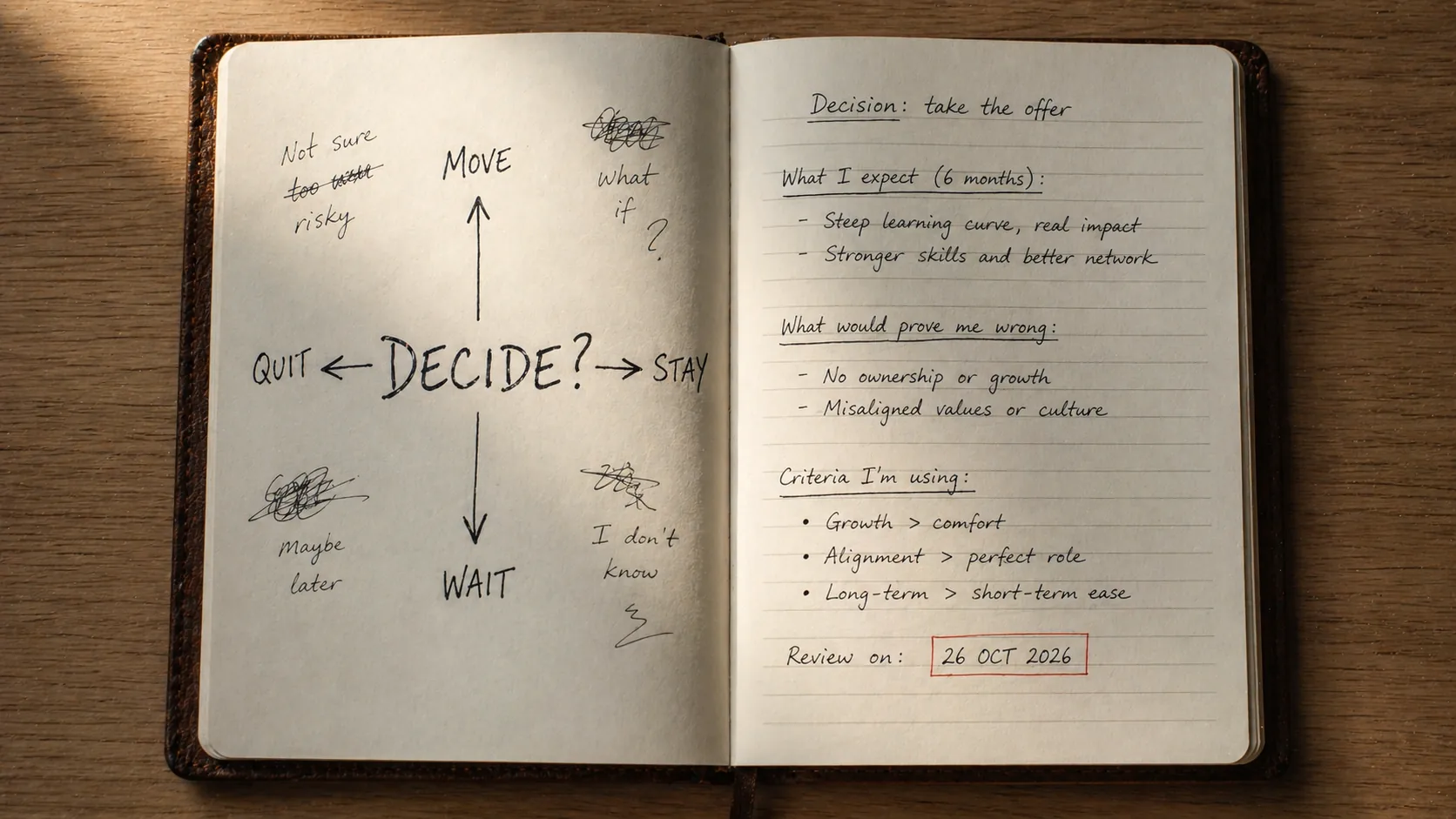
A decision journal is a short, dated entry written before you act, capturing the choice you are about to make, what you expect to happen, the reasons behind your call, and a date on which you will review it. The format was popularised in finance by writers such as Shane Parrish at Farnam Street and by the poker player and decision researcher Annie Duke in her books Thinking in Bets (2018) and How to Decide (2020).
The structure is unglamorous. A typical entry contains a one-line description of the decision, the situation that prompted it, the alternatives you considered, what you expect each option to produce, the criteria you are weighing, your level of confidence, and a future date when the relevant outcome should be observable.
The practical rationale is to pin a forming opinion to a date and a page so it can be checked later. That rationale is not proof that a particular template improves judgement.
What Does the Research Say About Writing and Decision Quality?
Decision-journal advocates draw on several research traditions. None of the studies below tested whether keeping a decision journal improves real-world decisions. They offer relevant findings about memory, external reminders, goals, prospective hindsight, and self-talk; applying those findings to a structured journal is a practical inference, not a demonstrated effect.
Working memory is limited.
Nelson Cowan at the University of Missouri summarised the research on working-memory capacity in a 2010 article in Current Directions in Psychological Science: under constrained conditions, a central estimate is roughly four chunks. What counts as a chunk depends on the task and prior knowledge, so this is not a formula for how many options a person can compare.
Evan Risko and Sam Gilbert described cognitive offloading in a 2016 review in Trends in Cognitive Sciences: using external aids, including writing, to reduce what must be maintained internally. Putting options and criteria on a page may therefore reduce the need to hold every item in mind. The review did not test decision journals or show that offloading improves the quality of a choice.
External reminders can improve prospective-memory performance.
Sam Gilbert and colleagues at University College London reported in a 2020 paper in the Journal of Experimental Psychology: General that participants using external reminders in a laboratory memory task achieved 94–98% accuracy, compared with 52–55% when relying on internal memory. Those figures concern remembering task intentions, not making better decisions, so they should not be treated as an effect size for decision journaling. The relevant takeaway is narrower: a written record can preserve what you meant to revisit.
Specific goals often outperform vague instructions.
Edwin Locke and Gary Latham summarised thirty-five years of goal-setting research in a 2002 paper in American Psychologist. Across many settings, specific and challenging goals generally outperformed vague instructions such as “do your best.” The review did not isolate writing goals down and did not study decision journals. A journal can make a plan and its criteria specific, but the paper does not establish that recording them improves a decision.
Expressive-writing evidence is not decision-journal evidence.
In Klein and Boals's 2001 experiments, students assigned to write about coming to college showed working-memory changes relative to controls, and reductions in intrusive thinking were proposed as an explanation. The experiments did not involve decision entries or show that adding causal and insight words to a journal improves a choice.
A decision in your head is a feeling about what to do. A decision on the page is an argument with itself, with the seams visible. The seams are where the work is.
What Is a Premortem, and What Has Been Tested?
A premortem is a useful addition to a decision entry: imagine that the decision has already been made and has failed, then write possible reasons why. Its evidence base is indirect, however; the central experiment tested prospective hindsight, not written decision journals.
The technique was named by the cognitive psychologist Gary Klein in a 2007 piece in Harvard Business Review, but the underlying mechanism was shown two decades earlier. Deborah Mitchell, J. Edward Russo, and Nancy Pennington at the Wharton School demonstrated in a 1989 study in the Journal of Behavioral Decision Making that participants who used prospective hindsight — imagining that an outcome had already occurred and explaining why — generated about 30% more concrete reasons for that outcome than participants asked to forecast in the usual forward-looking way.
Prospective hindsight can prompt people to generate additional explanations, such as a mistaken assumption, a stakeholder not consulted, or a constraint treated as fixed. The experiment does not establish that it breaks an automatic “optimism reflex” or that more reasons necessarily produce a better forecast.
The study measured how many reasons people generated. It did not test whether writing a premortem changed their eventual choice or outcome. Recording those reasons can still make assumptions easier to inspect and revisit; that is a practical use of the technique, not a result the experiment established.
What Does Adjacent Self-Talk Research Show?
Fear, urgency, and attachment can make it harder to examine a choice from more than one angle. A page also gives you a convenient place to try self-distancing, but the evidence for that technique comes from self-talk research rather than decision journals.
Ethan Kross, Özlem Ayduk, and colleagues published a 2014 series in the Journal of Personality and Social Psychology spanning seven studies and 585 participants. Using one’s own name or non-first-person pronouns during introspection increased self-distance and changed some responses to social stress. The studies examined self-talk, not journal entries, bias reduction, or real-world decision quality.
A journal is one convenient place to try that wording because private writing avoids the awkwardness of speaking about yourself by name. That is a practical adaptation of the self-talk method, not evidence that self-distanced writing itself produces better decisions.
Using your own name on the page is one way to adapt the tested self-talk instruction. Whether that improves a decision remains an open question.
Our companion piece on how journaling improves self-awareness covers the mechanism in more depth.
Why Preserve a Before-the-Outcome Record?
A record made before the outcome can preserve what you predicted. Two well-documented biases explain why retrospective judgement alone may differ from the original view.
The first is hindsight bias. A 2012 review by Roese and Vohs describes it as involving memory distortion, beliefs about an event's likelihood, or beliefs about one's own ability to predict it after the outcome is known. It does not imply that every forecast shifts by a fixed number of percentage points.
The second is outcome bias. Across five experiments, Baron and Hershey (1988) found that knowledge of favourable or unfavourable outcomes affected participants' evaluations of decisions made under uncertainty, even when the information available to the original decision-maker was held constant.
Annie Duke uses “resulting” for grading a decision by its outcome rather than its process. A dated record cannot remove either bias, but it can preserve what you wrote before learning the outcome. No cited study tested whether a decision journal then improves learning.
This is the strongest practical case for a decision journal: it creates one usable source of feedback on your own judgement. It cannot tell you by itself whether the process was sound, but it gives you a record that memory alone cannot supply reliably.
Does Writing Things Down Reduce Decision Fatigue?
“Decision fatigue” is often used loosely, while the evidence around ego depletion and deteriorating choices is contested. The studies cited here do not establish that holding many open decisions causes lower-quality choices later in the day.
Writing can store the options and a review date outside your head, so you do not have to rely on memory for every detail. It does not follow that merely writing about an unresolved choice will stop intrusive thoughts, free a measurable amount of working memory, or eliminate decision fatigue.
A related but narrower finding comes from bedtime planning. In a 2018 one-night laboratory study, Scullin and colleagues assigned 57 healthy young adults to write for five minutes about future tasks or completed activities. The future-task group fell asleep about nine minutes sooner on average. The study did not include a no-writing group, test unresolved decisions, or confirm cognitive offloading as the mechanism.
For more on the cognitive-clarity mechanism, our piece on whether journaling helps you think more clearly covers the working-memory evidence in detail.
How to Start a Decision Journal
The smallest viable decision journal is one entry per significant decision, written before you act, with a review date.
One workable template covers these fields:
- The decision. One sentence: the choice you are about to make.
- The situation. What is forcing this now, and what would happen if you did nothing.
- The alternatives. The options you actually considered, including the ones you rejected quickly.
- What you expect. For your chosen option, the specific outcome you expect within a named timeframe.
- Your confidence. A rough percentage, recorded as an estimate rather than a claim of precision.
- What would prove you wrong. The premortem — what would have to happen for this to look like the wrong call in six months.
- Review date. When you will reopen this entry and compare prediction to reality.
You can keep the entry to one page or adapt the length to the decision. Research has not established a ten-to-fifteen-minute dose or shown that a longer entry means the decision has not been made.
The hardest discipline is the review. If you never reopen an entry, it remains a record rather than a comparison between prediction and outcome. A monthly calendar reminder is one practical way to revisit entries when they come due; no study has established it as the single intervention that makes decision journals work.
The journal preserves a dated account. Whether reviewing it improves the writer's later judgement has not been established directly.
When a Decision Journal Will Not Help
The practice has real limits, and they are worth being honest about.
Trivial decisions. Reaching for a journal every time you choose what to eat or which email to answer first will burn out the practice quickly. The leverage is in decisions that are large, slow, or reversible only at high cost — career moves, hires, financial commitments, big-ticket creative directions, relationship decisions. For everything else, writing is overhead.
Decisions you have already made. Writing after the fact is a different exercise — closer to a learning log than a prospective decision journal. Once the outcome is known, hindsight and outcome bias can shape the account; the cited work does not quantify how much weaker a retrospective journal would be.
Decisions made under acute crisis. When a choice has to be made in the next hour, writing it out can be the wrong move — the time pressure is real and the cognitive cost of structured reflection is non-trivial. The reverse case is also true: many decisions that feel like emergencies do not actually have to be made today, and the act of starting an entry sometimes reveals how much room the decision really has.
A decision journal also will not help you escape what the choice is genuinely about. If a decision is hard because two of your real values conflict, writing them down clearly will not dissolve the conflict — but it will at least let you see which value is winning, and at what cost. That is its own kind of progress.
For decisions that get stuck because the thinking itself is looping rather than moving, our piece on whether journaling helps with overthinking covers bounded ways to respond without promising to break every loop. For a simpler structure, see our practical guide on how to journal for clarity.
What Better Decision-Making Actually Feels Like
The hoped-for benefit is not a guaranteed improvement in any single decision. With enough entries to compare, you may start to notice how overconfidence sounds in your own voice, which risks you tend to underweight, which decisions you defer, and which premortem warnings you repeatedly ignore. Research has not established a threshold such as twenty entries.
A dated page makes your earlier account inspectable. That is a practical affordance, not an established psychological mechanism or a guarantee that you will interpret the record accurately.
If you want to test the practice, pick one real decision you face this week and write the seven fields above on a single page. Choose a review date that matches when the outcome should be observable; three months is an example, not a research-backed default. Reopen the entry before making another decision in the same category and see whether the record teaches you anything.