
Does Journaling Help You Learn From Mistakes?
Table of contents
Does journaling help you learn from mistakes? A journal can preserve what you expected, separate observation from interpretation, and hold a plan for the next attempt. Those are useful functions. The evidence does not show that a private entry automatically turns an error into learning or prevents it from recurring.
The closest research comes from deliberate reflection in training, after-action reviews or debriefs, repetitive-thought research, and assigned expressive-writing experiments. These studies tested different interventions and outcomes. Their results should not be combined into one effect of “journaling about mistakes.”
What Did the Wipro Reflection Study Find?
Di Stefano, Gino, Pisano, and Staats studied deliberate reflection after practice in laboratory and workplace settings. In the frequently cited Wipro field experiment, trainees assigned to spend the final fifteen minutes of training days writing about lessons learned scored 22.8% higher on the final assessment than trainees who continued practising during that time. The authors' revised working paper now describes a broader programme of reflection experiments.
The Wipro task was reflection on learning during a month-long training programme. It was not specifically a mistake journal, and the reported final-assessment advantage does not establish that the advantage persisted for another month on the job. Additional experiments explored self-efficacy, but they do not confirm one exclusive mechanism for every reflection exercise.
One written-reflection condition outperformed additional practice on one training assessment. That is evidence for a particular learning task—not proof that writing about any failure produces durable improvement.
Why Is the After-Action Review Evidence Different?
An after-action review (AAR), also called a debrief, is a structured process for comparing intended and actual performance, explaining the gap, and identifying changes for the next attempt. It may be facilitated or self-led, conducted by a team or an individual, and spoken, written, or documented after discussion.
Keiser and Arthur's 2022 meta-analysis covered 83 studies, 134 effect sizes, 955 teams, and 4,684 individuals. It reported a large overall effect of d = 0.92 for AAR or debrief interventions, with effectiveness varying by task and training characteristics.
That pooled number is not an effect size for written journaling. The review combined debrief packages, many of which involved discussion, facilitation, feedback, or team processes. It cannot tell us that private writing was the active component, that the mechanism is the same in every domain, or that transferring the questions to a personal journal preserves the pooled effect.
A journal can host an AAR-inspired exercise. That makes the exercise an adaptation of debrief logic, not a validated personal version of the meta-analysed intervention.
What Does Research on Concrete and Abstract Thought Add?
Edward Watkins reviewed constructive and unconstructive repetitive thought in a 2008 Psychological Bulletin paper. The review identifies several factors that may shape outcomes: the valence of the thought, the person's intrapersonal and situational context, and whether processing is relatively concrete or abstract.
Across parts of that literature, concrete processing of negative material was associated with more constructive outcomes than abstract processing. That does not mean concreteness always reduces distress or produces insight, and the review was not a trial of journals after mistakes. It offers a useful caution against turning one event into a global judgement about the self.
“The estimate was wrong because I omitted supplier lead time” is a testable account. “I always ruin everything” is global and difficult to act on. A concrete account can still be mistaken, however, and an abstract question can sometimes be useful. Evidence, context, and the purpose of the reflection still matter.
Our article on journaling and overthinking examines the difference between problem-solving and repetitive brooding without presenting one sentence form as a guarantee.
Do Narrative, Self-Talk, and Stress Studies Prove a Mechanism?
No single settled mechanism connects all of these findings.
Pennebaker and Seagal's 1999 paper on narrative formation discussed expressive-writing studies and language patterns associated with better outcomes. It proposed that organising an emotional experience into a narrative may matter. Associations between changes in language and outcomes do not prove that constructing a cause-and-consequence story is necessary, sufficient, or always accurate.
Kross and colleagues' 2014 series of seven studies examined non-first-person self-talk. Using one's own name or a non-first-person pronoun affected self-regulation in particular laboratory and social-stress tasks. The programme was about self-talk, not specifically written journals, and it does not show that changing a pronoun alone makes every review more accurate.
In a 2018 laboratory experiment by DiMenichi and colleagues, participants wrote about a past failure or a control topic and then completed either a psychosocial stressor or control activity. In the stress condition, past-failure writing was followed by an attenuated cortisol response and smaller sustained-attention deficits.
That result belongs to a specific sequence: one assigned writing task before an acute laboratory stressor. It does not show that writing had already resolved the old failure, that it freed working memory otherwise consumed by rumination, or that routine mistake journaling protects later performance in everyday settings.
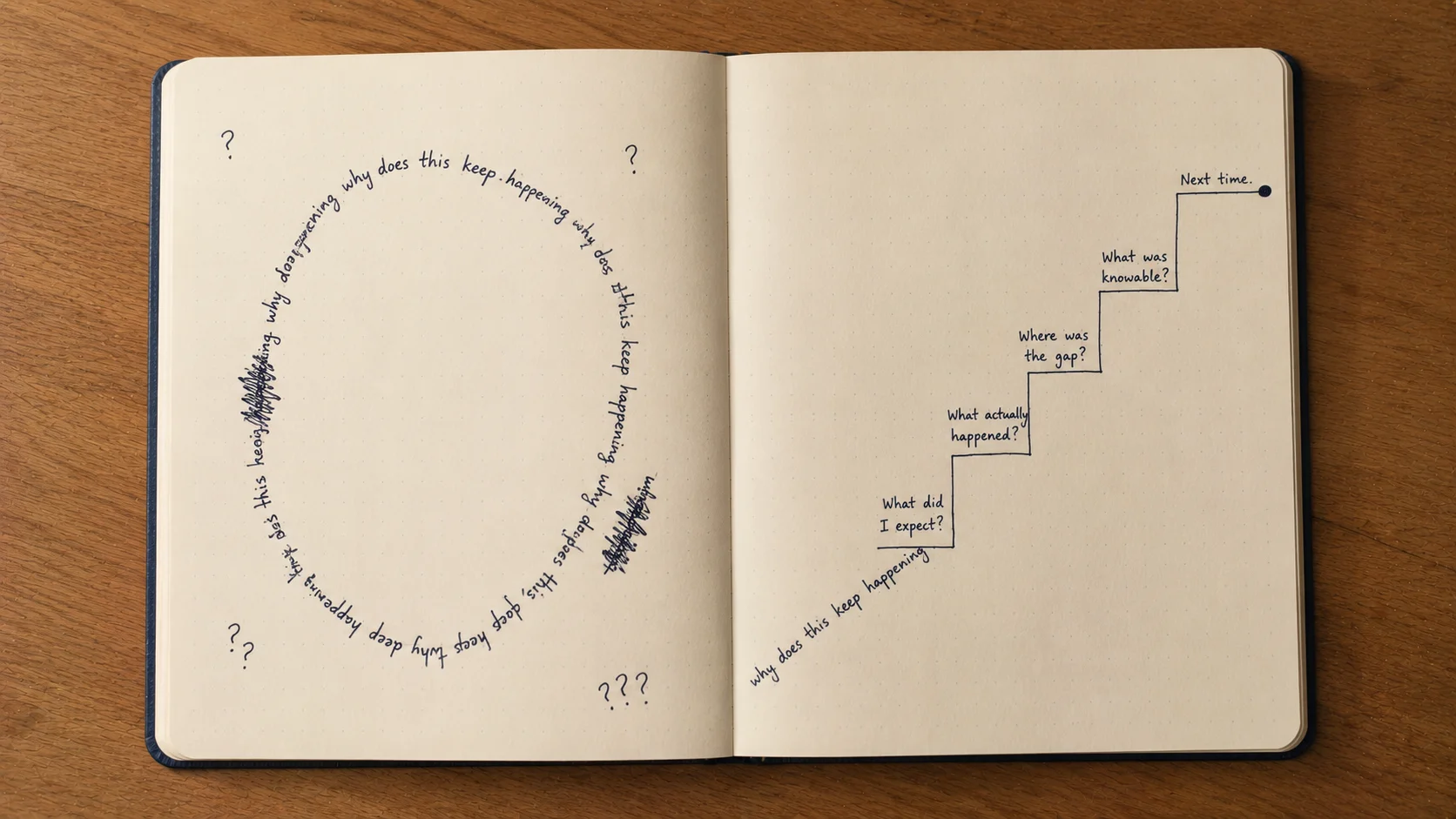
How Can You Adapt a Debrief to a Journal?
The following questions preserve useful parts of debrief structure. They have not been validated as a five-question personal-journaling protocol, and there is no known optimal page length or order.
What did I expect?
If a prediction or plan was recorded before the outcome, compare against that record. If it was not, acknowledge that your reconstruction may be influenced by knowing what happened. Do not invent certainty you did not have at the time.
What actually happened?
Start with observable events, measurements, and words before interpreting motives. Separate “the client ended the call after two minutes” from “the client thought I was incompetent.” The first may be known; the second may need evidence.
Where is the gap?
Compare intended and actual performance. A gap can come from the plan, execution, missing information, chance, another person's actions, or a constraint that no one controlled. Naming a single cause too quickly can create a tidy but false lesson.
What was knowable then?
Distinguish a signal that was available from one visible only in hindsight. This protects against blaming your earlier self for information that emerged later. It also makes a genuinely missed signal easier to specify.
What is one change to test?
Choose a change that fits the proposed cause and can be observed on a similar next attempt. “Be more careful” is hard to evaluate. “Before quoting a date, check the supplier lead time” is testable. Treat it as a hypothesis, not proof that the error has been solved.
For decisions that can be recorded before their outcomes, our article on journaling and decision-making explains why contemporaneous predictions are more informative than reconstructed ones.
What Can a Journal Record That Memory Cannot?
A dated entry preserves what you wrote at that moment. It can reveal that a warning was noticed, that confidence was lower than remembered, or that a later explanation was absent. The record is still incomplete: people omit details, misunderstand events, and sometimes write to defend a preferred story.
Re-reading several entries may suggest a recurring context, but a pattern in a small personal record is not automatically causal. A run of missed deadlines might share one constraint, or it might combine unrelated causes. Use the journal to generate questions and check evidence rather than to diagnose a permanent trait.
This is also why feedback matters. Other people may have information the writer lacks, especially in team work or interpersonal conflict. A private review can prepare better questions, but it cannot reproduce a facilitated debrief or independently verify another person's motives.
When Can Writing About a Mistake Make Things Worse?
Writing can become repetitive self-criticism, intensify distress, or create false confidence in one explanation. There is no reliable rule that short-term discomfort is a normal “price of insight.” If an entry leaves you increasingly distressed, disoriented, or unable to function, stop rather than forcing a lesson.
Do not use a journal as the sole response to harassment, abuse, unsafe working conditions, a medical problem, or a mental-health crisis. Those situations may require practical protection, qualified care, or support from another person—not a better interpretation of your own behaviour.
If self-criticism or intrusive memories are significantly affecting sleep, relationships, or daily functioning, consider speaking with a qualified mental-health professional. If you may act on thoughts of suicide or self-harm, or someone is in immediate danger, contact local emergency services now. Find A Helpline lists verified crisis services in more than 175 countries.
How Soon and How Often Should You Review a Mistake?
The research does not establish a best delay after a personal mistake. Writing immediately may preserve detail but can be difficult when emotion is intense; waiting may make reflection easier while allowing memory to change. “Within twenty-four hours” is a practical option, not an evidence-based cutoff.
A 2023 meta-analysis by Guo examined 31 randomised expressive-writing trials with 4,012 participants and longer-term depression, anxiety, and stress outcomes. Studies using one-to-three-day intervals between assigned expressive-writing sessions showed stronger pooled effects than studies with longer intervals.
That moderator does not compare daily mistake reviews with spaced mistake reviews. It does not show that daily journaling about one error entrenches it, prescribe a follow-up after two or three days, or establish that fifteen to twenty minutes is optimal for learning. Expressive disclosure and an AAR-inspired review are different tasks.
Use response and purpose as guides. One review may be enough. Revisit it only if new evidence appears or a similar situation provides a chance to test the planned change. Rewriting the same conclusion without new information is unlikely to improve its accuracy.
What Is a Realistic Conclusion?
A journal can make learning work visible. It can preserve an expectation, organise evidence, expose an unsupported interpretation, and document one change to test. Structured written reflection improved performance in a particular training experiment, while broader AAR evidence supports debrief packages rather than private writing specifically.
None of this guarantees that the lesson is correct or that the mistake will not recur. Outcomes also depend on feedback, opportunity to practise again, environmental constraints, and whether the chosen change addresses the real cause.
For consequential errors, individual reflection is only one layer. A team may need incident reporting, an independent review, changes to tools or staffing, and a way to verify that corrective action worked. Framing a system failure as a lesson one person should extract in private can hide the conditions that made the error likely.
Use the page as a record and a hypothesis, not as proof that reflection has already produced learning.
If you want to try it, choose one low-stakes recent event and answer the five questions once. Mark which parts are observations, which are interpretations, and what evidence could disconfirm the proposed lesson. On the next comparable attempt, check the result. That loop is more informative than counting entries or waiting for a promised number of weeks.
For the related limits of performance writing, see why high performers journal. For the broader question of patterns and feedback, see our article on journaling and self-awareness.